

Bradman of St George
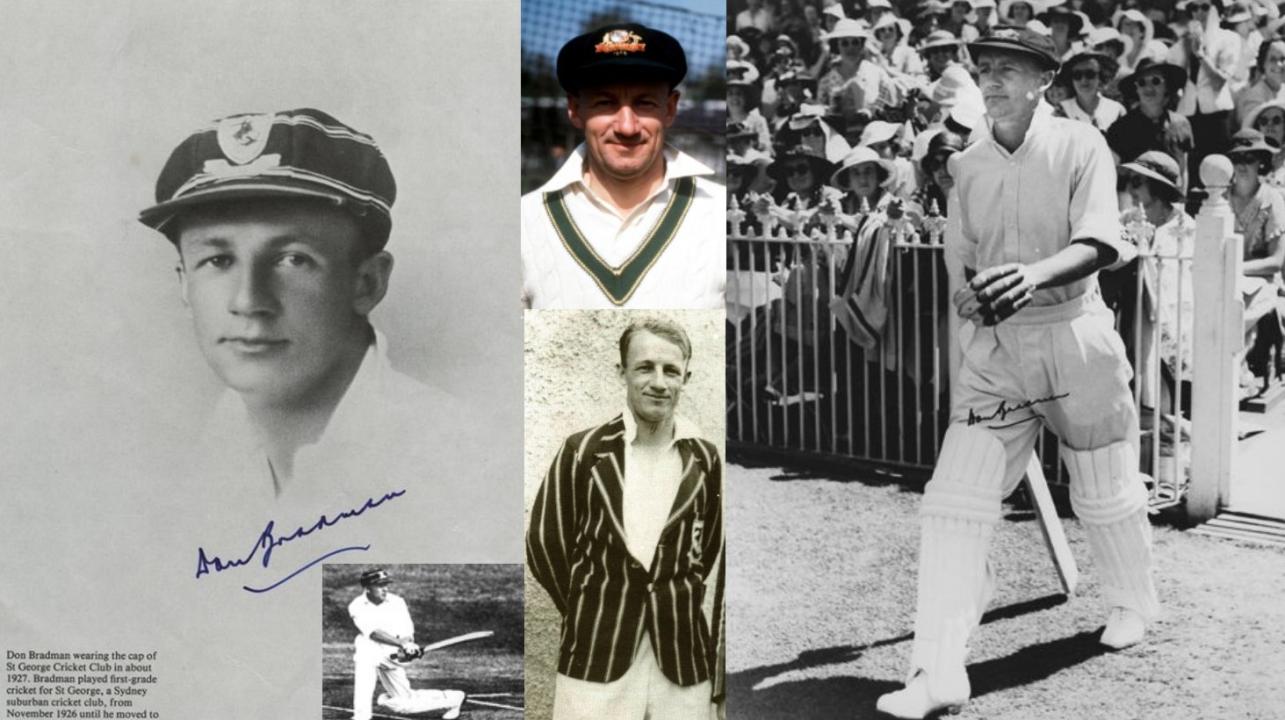
Don Bradman was born on this day, the 27th of August in 1908 at Cootamundra in country New South Wales in 1908. He was brought up in Bowral, in the Southern Highlands, where he learnt and ‘practiced’ his cricket.
CRICKET
He played for St George for 7 seasons - from 1926-27 to 1932-33 inclusive. He played his first game for St George in November 1926 (in First Grade of course) at the age of 18 and scored 110 run out against Petersham at Petersham Oval against one of the strongest bowling attacks in the competition. In making this century, he figured in a record 5th wicket partnership of 197 with C. Targett (who made 150 n.o.) a record that stood for over 75 years. In this season he scored 289 runs at 48.1.
The next season, when 19, he played his first Sheffield Shield match and scored 118 against South Australia who had the current Test leg-spinner in their attack. He also posted 134 against Victoria that season - his first century at the S.C.G. For St George he made 402 runs for the season.
The 1928-29 season saw him make his Test debut at the age of 20. He failed on a wet wicket in the first Test against England and was dropped to 12th man for the Second (must have been the only time he was dropped from a team). He was reinstated for the remaining three Tests and posted 2 centuries, a couple of 60’s and a couple of 40’s. In scoring his first Test century of 112, he became the youngest player to score a Test century (at 20 years and 4 months). St George’s Alan Fairfax was also selected for Australia in this series (in the 5th Test) but Bradman had become the first St George player to play Test cricket and Fairfax the first local boy to go on and play test cricket for Australia.
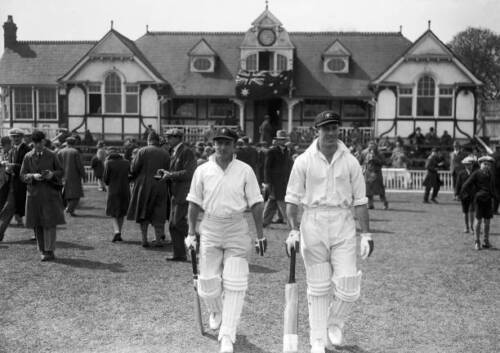
St George boys, Bradman and Fairfax batting together in their Baggy Greens
In Sheffield Shield, Bradman scored 340 n.o. against Victoria and a century in each innings against Queensland. The heavy representative season meant that he played only 4 innings for St George with an aggregate of 261.
In 1929-30, Bradman broke a club record when he hit 187 against Randwick and 180 against Glebe. In all his aggregate for St George was 549 at an average of 109.8.
This season he made the mammoth innings of 452 n.o. against Queensland, surpassing the 437 by Victorian Bill Ponsford and Bradman scored his runs a lot quicker. Bradman and Fairfax both went on the 1930 tour of England, the first St George players to tour England.
On tour he made 2960 runs at 98.66. Bradman regarded his innings of 254 in the second Test at Lords as the most perfect innings, technically, of his career. Then in the third Test at Leeds he scored 334, including 309 in a day. The innings had 46 fours but no sixes! In doing this, Bradman beat the highest Test score of 287 by R. E. Foster for England at Sydney in 1903 and almost doubled the highest tour score, 170, made by Dr. W. G. Grace, the “father” of cricket, against the Australians in 1886.
The most remarkable feature was Bradman’s scoring 1000 runs in an Australian season for four successive years. Only three other players had done it - W. H. Ponsford, C. G. Macartney and D. G. Bradman. He joined Macartney in scoring a century before lunch. But he had not yet made two centuries in a Test match, as Bardsley did in 1909.
Bradman played his first Test cricket against the West Indies in 1930-31 and in this season he scored his 10th double century.
1931-32 saw him score 246 against Randwick. Other innings were 201 against Gordon and 128 against Paddington. In all, for St George, he made 785 runs at an average of 112. Bradman broke the St George batting aggregate record by beating Louden the previous season and he also posted 1000 runs in an Australian season for the second time and now had 36 centuries in 5 seasons of first class cricket.
1932-33 was Bradman’s last season at St George, the season of the “bodyline” test series against England. In this season he scored 512 runs at 47.4 with a highest score of 134.
His St George career aggregate was 44 innings, 3013 runs at 91.30, highest score of 246 and 13 centuries.
Bradman played 52 Tests. When he finished at St George, at the age of almost 25, he had been playing Test cricket for over 4 years and had played 23 Tests, almost half his Test career! In these Tests he had 34 innings and scored 3091 runs at an average of 99.71, with 1 triple century, 5 double centuries and 7 centuries.
RESIDENCE
Bradman played his first two seasons at St George whilst living in Bowral. He travelled to Sydney by train - leaving home at 6 a.m. and returning home at midnight.
In 1928 he moved to Sydney and soon came to live with the family of Frank and Jessie Cush at Rockdale. Frank Cush was a long time administrator at the St George District Cricket Club and he had a hand in encouraging the young Don Bradman to come and play at St George.
He lived at Rockdale until 1932. Following his very successful tour of England in 1930, Don Bradman was given a red “Chev” motor car and he often parked it outside the Cush home at Rockdale. It became a talking point for the neighbourhood.
He moved to North Sydney in 1932 but played the following season at St George because of the residential qualifications.
He later moved to South Australia in February 1934.
21ST BIRTHDAY AND MARRIAGE
Don Bradman’s 21st birthday was 27th August 1929. The St George wicketkeeper in the late 1920’s, Harold Fraser, after whom the Oval on the Prince’s Highway at Carss Park is named, put on a function at his home at Sans Souci for the occasion. Ernie Laidler who succeeded Fraser behind the stumps at St George, and stayed for 30 years, was one of the guests.
Don Bradman married Jessie Menzies at Burwood in Sydney in April 1932. He was married from the Cush home in Rockdale.
HONOURS
Don Bradman was knighted in 1949 and was invested as a Companion of the Order of Australia in 1979.
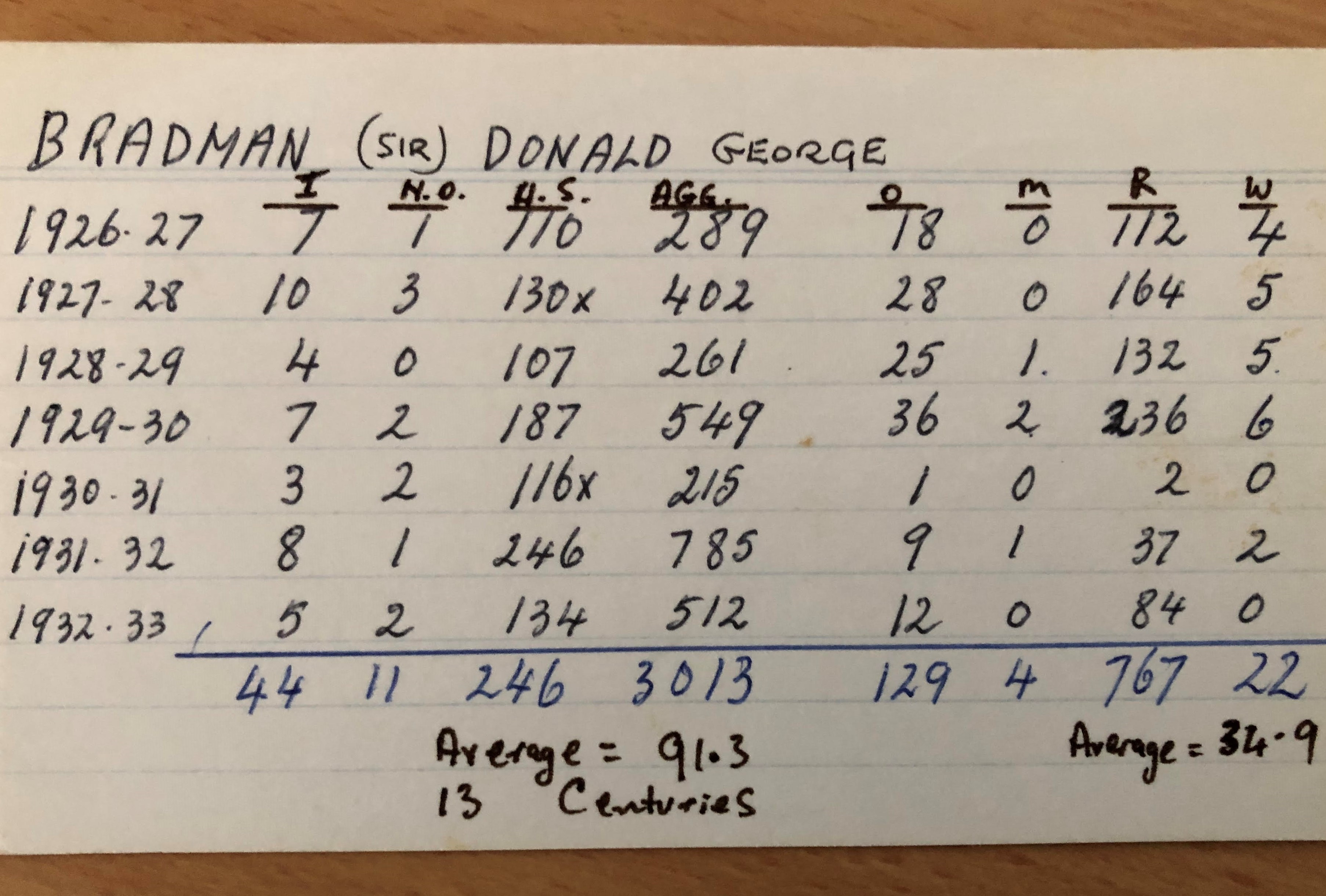
Amazing item of history, Bradmans handwritten datacard for St George DCC

Clip from the Captains Circle on BeaconPoint Cricket with Paul Ryan - setting the field for left arm swing bowlers